F
A presentation by Robert Riopel

The End
of Figma.

What design tools taught us, why they're disappearing, and what comes next.

Scroll to begin
01 — What is Figma

Let me tell you about Figma.

Figma launched in 2016 and changed everything — browser-based, real-time, and collaborative, it killed the clunky hard-drive tools designers had been fighting with for years.

If you worked in product design between 2017 and 2023, understanding Figma deeply was a career skill — it was the tool that separated designers who knew what they were doing from designers who didn't.

02 — The Adobe Moment

Adobe tried to buy it
for $20 billion.

In 2022, Adobe announced it would acquire Figma for $20 billion — the largest design software acquisition in history — only to have European regulators block the deal in late 2023.

Adobe had decades of dominance with Photoshop, Illustrator, and XD, and still felt the need to spend $20 billion to neutralize a 6-year-old startup.
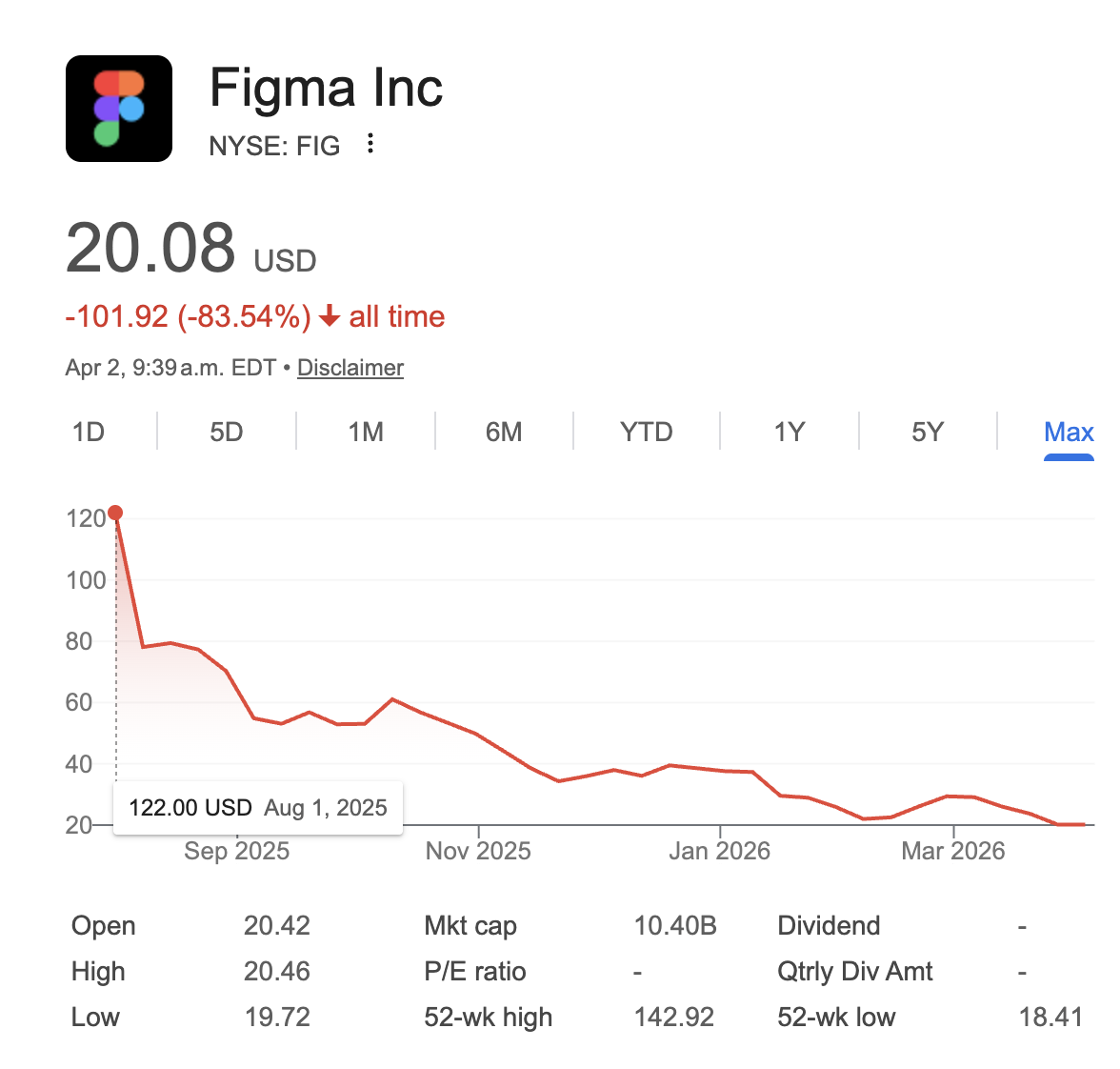
Figma stock price since IPO
Figma — stock price since IPO

BUT the real threat to Figma was never Adobe. It was something else entirely.

03 — The Real Threat

Artificial
Intelligence.

The thing Adobe couldn't buy its way out of.

04 — Two Things I Built

Here's what
I shipped.

Here are two things I've shipped at RVezy that didn't exist in a designer's toolkit two years ago.

01

The Email Builder

Our email production workflow was: design in Figma, export with Emailify (the worst plugin ever built), hand off to Braze, fix everything that broke.

In just a few days I built an internal Next.js tool that replaced the entire chain — pick a template, configure blocks, preview in dark and light mode, copy the HTML. No Figma. No code.

→ Live Demo
02

The Figma Plugin — and the Brain Behind It

I built an AI-powered Figma plugin that generates production-ready Vue and Tailwind components pulled directly from our design system.

The brain behind it is those two files — the design system doc and the color registry. The plugin is just the hands.

rvezy-design-system.md
# RVezy Design System v2.0
# Vue 3 + Tailwind CSS v4

## Button
Variants: default | highlight | secondary
Sizes: sm (h-9) | md (h-11) | lg (h-13)
Always: rounded-full, border-2, font-semibold

default:   bg-primary-950 text-white
highlight: bg-secondary text-white
secondary: bg-white text-primary-950

## Badge
success: bg-green-100 text-green-700
warning: bg-orange-100 text-orange-700
error:   bg-red-100 text-red-700
colors-rgb.json
// Brand colors as RGB values
// readable by any tool or model

"primary": {
  "500": { "r": 0.184, "g": 0.706, "b": 1.0 },
  "600": { "r": 0.153, "g": 0.427, "b": 0.973 },
  "950": { "r": 0.075, "g": 0.145, "b": 0.345 }
},
"semantic": {
  "secondary": { "r": 0.153, "g": 0.427, "b": 0.973 },
  "white":     { "r": 1.0,   "g": 1.0,   "b": 1.0 },
  "black":     { "r": 0.0,   "g": 0.0,   "b": 0.0 }
}
→ Live Demo
05 — How I Work Now

Figma is the
last step.

Let me walk you through how I actually explore a new design idea today. Two tools. Neither of them are Figma.

Tailwind CSS is a framework developers use to style websites.

Stitch is a Google Labs tool that turns a plain English description into a working UI. It runs entirely in your browser and when you're happy with a direction, you paste it straight into Figma.

So here's the workflow: find a component in Tailwind → describe in Stitch → refine → paste to Figma. Figma is still there. But it's no longer where ideas are born.

Tailwind
Design language
Stitch
AI exploration
Figma
Final polish
→ Live Demo
06 — So Is Design Dead?

The tool was
never the skill.

A designer's career has historically been built on being very good at specific software — Figma, Photoshop before that, XD in between.

So when I say Figma is losing relevance, I'm saying it as someone whose identity was tied to it.

The designers who are thriving right now aren't the ones who resisted these tools — they're the ones who recognized what actually made them good in the first place. It was never really about the software.

AI can generate a UI in seconds, but it cannot tell you whether that UI respects your user. That part still requires a human.

In a world flooded with AI-generated interfaces, taste is becoming rarer and more valuable, not less. I'm not watching this shift from the outside — I'm building inside it, at RVezy, every day.